Questions
General
Probes
How To Use
Answers
General
AFM (Atomic Force Microscopy) is a widely-used instrument and technique for non-destructive surface investigations as well as for surface modifications at the nanoscale. Besides topography, AFM is capable of collecting information that relates to local material properties such as adhesion, stiffness, elasticity, conductivity, coercitivity, etc.
The principle of AFM consists in registering the force experienced by the probe from the sample as the probe scans its surface. There are other scanning techniques like STM or NSOM, where the probe is designed to register other physical values. All these techniques and instruments are referred to as SPM (Scanning Probe Microscopy). So AFM is a part of SPM.
AFM is a widely used technique in life science, chemistry and materials research, where the structures and processes at micro and nanoscale are of interest.
MikroMasch offers AFM probes and test structures.
The probe is a key part of any AFM experiment. One of the most important characteristics of a probe is its sharpness, that determines the resolution. Extremelly sharp probes with subnanometer radius can provide true submolecular resolution in ambient conditions. Any probe also have to provide means to transfer the force signal to the AFM system.
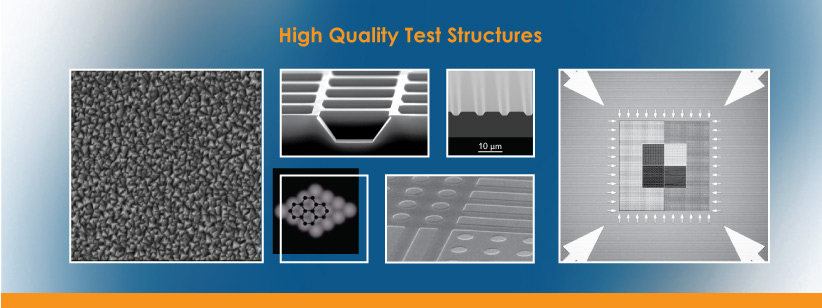
The test structures provide means to check the system performance in many aspects. In combination with special techniques, the test structures can be used for calibration purposes.
Basically a chip is a relatively large piece of silicon to which one or several cantilevers are attached (see Fig.). Cantilevers (or just levers) are thin beams of silicon or silicon nitride. They usually have rectangular or triangular shape and well-defined mechanical properties. Finally, a tip is a very sharp protrusion at the end of a cantilever, although cantilevers themselves are often referred to as 'tips' as in 'contact tips', for example.
 |
| Fig.1 Chip, cantilever, and tip |
Our products are compatible with the microscopes of all major SPM manufacturers, including Veeco, (Digital Instruments, ThermoMicroscopes), Agilent, Asylum Research, JEOL, PSIA, Burleigh, and others. Note that to use cantilevers in ThermoMicroscopes SPM you need to mount them first.
The dimensions of the chip are 1.6 mm x 3.4 mm x 0.4 mm.
Probes
We use monocrystalline silicon for manufacturing cantilevers.
The tips point in the <100> direction, the edges of cantilevers are along the <110> direction.
Young's modulus of elasticity E = 1.69*10^11 N/m^2 (in the <110> direction)
Shear modulus G = 0.5*10^11 N/m^2
Density = 2330 kg/m^3
For NSC/CSC cantilevers, we use Phosphorous-doped Silicon (n-type), GP probes are made from Boron-doped Silicon (p-type). The concentration of the dopants is from 1017 cm-3 to 5*1017 cm-3.
The specific resistance of Si is 0.01-0.05 Ohm*cm. However, in air, silicon always has a native oxide layer, which is not conductive. You can try to remove it in UHV and use cantilevers in UHV immediately, because in air the native SiO layer will grow again very soon. You can also purchase cantilevers with conductive coating like Ti-Pt.
Reflective coating is deposited on the backside of cantilevers to increase the reflected laser signal and prevent interference of light reflected from the two surfaces of the cantilever (silicon is semi-transparent, so some portion of the incident beam is reflected from the backside, and some from the tip side). The most popular reflective coatings are gold and aluminum. Reflective coating is not used when cantilever already has another type of overall coating (conductive or magnetic).
Important! Use uncoated cantilevers whenever experimental conditions may lead to the corrosion of the reflective coating. If you need any probe without the reflective coating, you should specify this in the part number.
To answer on your question, we washed away coatings from different cantilevers. Typically, after washing the frequency goes down very slightly. For example, for CSC17 the difference in the frequencies of coated and uncoated cantilevers is on the order of 30-50 Hz (the fundamental frequency is about 12 kHz).
The reason is that the cantilever does not behave like harmonic oscillator and its spectrum has additional resonant peaks at higher frequencies. These peaks can be assigned to different oscillation modes of the cantilever or even oscillations of the microscope head.
If you use autotune, you probably see resonance of high order. Try manual tune and limit the range of scanning frequencies.
The elastic modulus of Si changes as a function of temperature, which brings about the variation of the resonant frequency. The composition of the atmosphere is also crucial when you are talking about such precision. In the case the difference in gas density and friction influences the q-factor and the shift of the resonant frequency with respect to that in vacuum.
A: Some of our chips have more than one cantilever. In this case, instead of calling them "left short cantilever" or "middle long cantilever" we use one-letter names. The letters by themselves do not have any meaning, refer to the description of a specific series for specifications.
 |
| Fig.2 Silicon chip with cantilevers. |
Yes. Cantilevers of all our standard models can be manufactured without tips (minimum order - 15 chips). We can also custom make cantilevers for you (minimum order - 200 chips). As a matter of fact, we receive quite a few orders for tipless levers. So there are often some in stock and ready for delivery. You may want to check this out with our sales people.
The standard box contains 5, 15 or 50 silicon chips with cantilevers.
How To Use
It is not necessary. Although you cannot control the force applied by the lever you are not using, in most cases nothing will happen to it and you will be able to use it later (e.g. by realigning the laser).
Unfortunately this important question does not have a simple answer. A lot will depend on the properties of your sample and imaging conditions and there is often a trade-off of some sort. Here are a couple of general remarks.
In contact mode soft levers should be used to minimize damage to the sample and the tip. However, very soft levers are noisy.
In tapping mode stiff levers are used so that the tip does not stick to the sample surface. Cantilevers with very high resonance frequencies (and force constants) allow faster scanning but can damage very soft samples. Rectangular cantilevers are preferable because they typically have better Q-factors than triangular ones.
Basic techniques and recommended types of cantilevers for different SPM applications are described in our "how-to-choose" chapter.
We have tip coated with silicon nitride (which is a hard material) mounted on cantilevers of different stiffness. The stiffest cantilevers could be tried for this application depending on the state of your Si/Si oxide surface.
The best choice will be Hi'RES probes, which have a curvature radius of about 1 nm. The choice of the force constant of the cantilever basically depends on the mechanical and adhesion properties of your sample. As the probe is very sharp, it requires special care in use, especially in engagement procedure. Our experience shows that many users break the tips during the first tests.
We have made some recommendations on how to use the probes on Nanoscope.
Yes. Try the NSC36 probes. These cantilevers are the shortest and suffer the least dumping forces in liquid media. Corresponding resonance peaks (10-35 kHz in water) are clearly seen in a cantilever tune.
We produce Porous Aluminum test sample for this purpose. It has a ordered structure of sharp edges and spikes over the surface. The pitch of the Porous Aluminum structure is 250..300 nm, curvature radius of the spikes is about 3..5 nm.
You also need a deconvolution program. We recommend to use Image Metrology software SPIP available for downloading from Image Metrology.
The shelf life of the tip varies depending on conditions of storage. In a desiccation jar, the shelf life is from half year to one year. When without desiccation, the shelf life will depend on humidity. Generally, it's recommended to use the tips within three months from the shipment date.
The best way to get rid of dust particles (not organic contamination) will be to softly blow on the grating with pure nitrogen or Ar.
Important! You should not wipe the grating with anything.